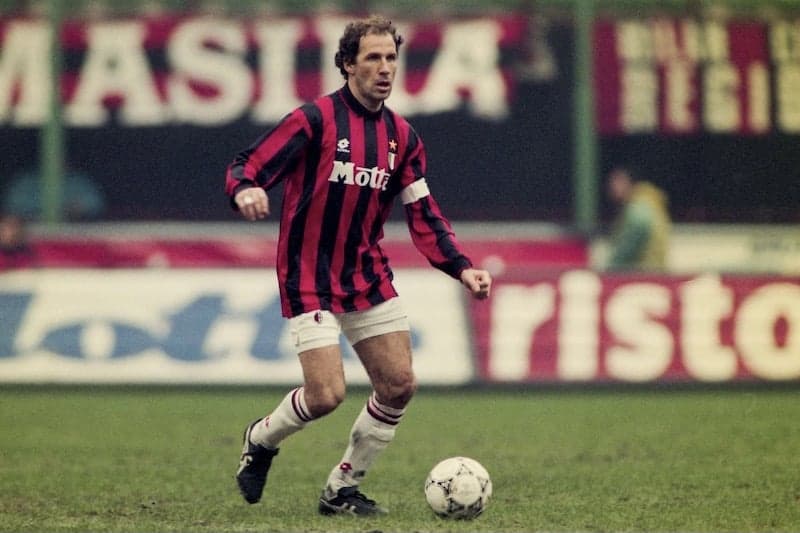
.The departure of Italian Franco Baresi... the world of football bids farewell to one of the last masters of the "libero." | Dimalions
The departure of Italian Franco Baresi... the world of football bids farewell to one of the last masters of the "libero."
about 2 hours ago
Sport
The departure of Italian Franco Baresi... the world of football bids farewell to one of the last masters of the "libero."
Hesspress Sports·
With the passing of Franco Baresi yesterday, Friday, at the age of 66, football has lost one of its most prominent defenders in history, a player who redefined the role of the defender in the modern era; he made positioning, reading the game, and calm leadership tools that surpassed physical strength and aggression. He was not just a captain of AC Milan or one of the heroes of the Italian national team, but he became a tactical reference that inspired entire generations of defenders, with the Dutch Marco van Basten describing him as "the Johan Cruyff of defenders," referring to the impact he left in this position as Cruyff did in attacking football.
Franco Baresi was born on May 8, 1960, in the town of Travagliato near Brescia, and he experienced a tough childhood after losing his parents at a young age, finding himself and his older brother Giuseppe facing life as orphans. This experience left a deep mark on his personality, making him more reserved and introverted. He later admitted that football was his only means of expressing his feelings, saying: "What I went through made me lean towards being a bit introverted, and when I was on the field, I gave everything I had, and perhaps I expressed there all the things I couldn't express away from football."
While his brother Giuseppe chose to defend the colors of Inter Milan, Franco's fate was to be linked to the traditional rival, Milan, beginning one of the rarest loyalty stories in the history of the game, a relationship that lasted twenty years as a player and continued after retirement through administrative and representative work within the club.
Baresi joined the first team in 1977, after being given the opportunity to debut by Swedish coach Nils Liedholm at the age of seventeen. He quickly established himself as a key player thanks to his exceptional ability to read the game, the precision of his interventions, and his excellent positioning; qualities that compensated for a relative lack of height and physical build compared to many defenders of that era, as he believed that the best intervention is the one that prevents the attacker from reaching the ball at all, rather than one that ends with winning it after a violent clash.
Baresi was not a traditional defender; he was a mind managing the team from the back, initiating attacks as well as finishing them, constantly directing his teammates, and expertly leading the offside trap, making it one of Milan's most prominent features in the late 1980s. Therefore, many considered him the last master of the classic "libero" position, one of those who transformed this role from merely a covering player to a primary playmaker.
At the age of twenty-two, he wore the captain's armband for Milan, becoming one of the youngest captains in the club's history; however, his beginnings were not paved with successes, as he lived with the team through one of its toughest phases, after Milan was relegated to the second division twice; the first time in 1980 due to the famous betting scandal "Totonero," and the second due to poor results. While many stars preferred to leave, Baresi chose to stay, contributing to the club's return to the top division on both occasions, becoming a symbol of loyalty before becoming a legend on the field.
Milan's history changed in 1986 with the arrival of Silvio Berlusconi as club president, followed by the appointment of Arrigo Sacchi as the team's coach, as Sacchi led a tactical revolution that changed the face of European football. Baresi was a cornerstone in it, building with Paolo Maldini, Mauro Tassotti, and Alessandro Costacurta one of the greatest defensive lines in the history of the game, a defense that did not rely on retreating but on collective pressing, advancing forward, and strict adherence to organization, ideas that required a leader with exceptional intelligence and a great ability to read the finest details of the match.
Behind this line shone the famous Dutch trio Ruud Gullit, Frank Rijkaard, and Marco van Basten, making Milan the strongest team in Europe, winning three titles in the European Cup in 1989, 1990, and 1994, in addition to six titles in Serie A; while Baresi became a reference for every coach wishing to study the art of defensive organization.
His impact was not only collective; he achieved an exceptional individual presence, finishing second in the Ballon d'Or in 1989 behind his teammate Van Basten; a rare achievement for a defender, before Milan later named him the best player in the club's history, in recognition of what he contributed throughout his career.
Baresi played 719 matches for Milan between 1977 and 1997, a number that remained a testament to his loyalty to the club, scoring 33 goals during that time, before announcing his retirement, leading Milan to retire the number 6 jersey; a step reserved for players who leave a mark that transcends results and titles.
With the Italian national team, he played 81 international matches and was part of the squad that won the World Cup in 1982 in Spain, although he did not participate in any match due to his young age; however, his international career also saw many moments of frustration, as he missed the 1986 World Cup and then experienced the bitterness of being eliminated from the semi-finals of the 1990 World Cup against Argentina on penalties.
His most painful moments came in the 1994 World Cup final in the United States, as after suffering a tear in his meniscus during the tournament, he underwent surgery, and everyone thought the tournament was over for him; but he made an extraordinary return to the final against Brazil less than a month after the surgery, delivering a great performance, before the two teams went to penalties, where he missed the first Italian penalty, and then Daniele Massaro and Roberto Baggio missed two more, leading the cup to Brazil, a moment that remains one of the most impactful scenes in the history of Italian football.
Despite that disappointment, Baresi continued to view his career with calm and balance, stating in an interview with FIFA on the occasion of his sixtieth birthday: "I finished my career as a world champion, then as a runner-up, then in third place; I cannot complain"; a phrase that reflects his balanced personality, far from exaggeration and emotion.
Baresi's legacy was not limited to what he achieved on the pitch; he became a reference for entire generations of defenders, with many stars admitting they were inspired by his style of play; among them was Paolo Maldini, who inherited the leadership of Milan's defense, followed by Fabio Cannavaro, Alessandro Nesta, and other great Italian defenders who found in his experience a model to emulate.
After retiring in 1997, he did not leave the club he was associated with throughout his life, as he held the position of vice president, then oversaw youth teams, before taking on some representative tasks and becoming an ambassador for Milan at various events, maintaining his presence within the institution that made his name and crafted its history.
In his last interview with "Gazzetta dello Sport" in 2025, he was asked about the feeling that encapsulates his long journey with Milan, and he simply said: "Deep gratitude"; a phrase that summarizes the relationship he had with the club, the fans, and football itself.