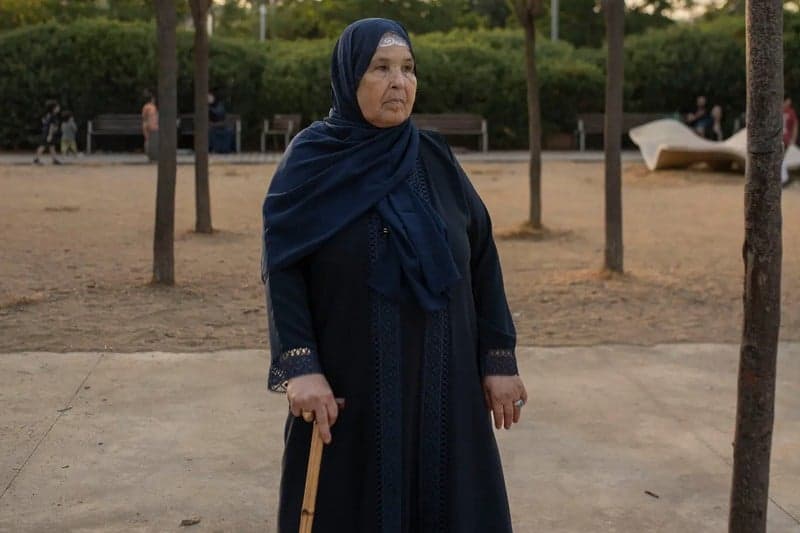
.Grandma Fatima recounts Yamal's journey from racial insults to the hearts of the Spaniards. | Dimalions
Grandma Fatima recounts Yamal's journey from racial insults to the hearts of the Spaniards.
9 days ago
Sport
Grandma Fatima recounts Yamal's journey from racial insults to the hearts of the Spaniards.
Hesspress Sports·
Hours before the Spanish national team competes in the 2026 World Cup final, Lamine Yamal's presence in the Spanish scene is not limited to being one of the team's brightest stars and one of the best football talents in the world. The 19-year-old player has become a focal point for a political and social discussion that transcends the football field, addressing issues of identity, belonging, migration, and the future of Spanish society. The American newspaper "The New York Times" views his rise from a working-class neighborhood near Barcelona to leading his country’s team in the biggest football tournament as a mirror reflecting the profound transformations Spain is undergoing, amid increasing numbers of migrants and a heated political debate about their status within society.
In a field report prepared by its correspondent Jason Horowitz from the Rocafonda neighborhood, the player's birthplace, the newspaper describes the exceptional atmosphere experienced by residents during the Spain vs. France match in the World Cup semifinals, where hundreds gathered in front of a giant screen in a park to watch the local boy lead his country’s team to the final. Not far from them was the small pitch where Yamal learned the basics of football, now adorned with a huge mural of his image, reflecting the status he has attained in the neighborhood that witnessed his beginnings.
Amid this atmosphere sat Fatima Romani, the player's grandmother, watching children run after the ball in the same place where her grandson took his first steps. She told the newspaper that her memories are not only tied to the success he is experiencing today but also to the difficult years when he faced racist remarks due to his Moroccan and African origins. Some spectators would hurl derogatory terms at him after he scored goals, which left a mark on the family, before many Spaniards' perceptions of him changed over the years. Grandmother Fatima confirms that Spanish society has undergone a noticeable change compared to what it was before, and that her grandson is now widely loved within the country.
The player, officially known as Lamine Yamal Nasraoui Ibana, has Moroccan roots from his father’s side and Equatorial Guinean roots from his mother’s side. He was born and raised in Spain before joining the famous Barcelona academy, where his talent emerged at an early age, quickly making his way to the first team and then the Spanish national team, becoming one of the most prominent sports figures in the country in a short time. However, the newspaper notes that his sporting success has coincided with his transformation into a symbol of the discussion about the meaning of belonging in a multicultural society.
Yamal himself brought this discussion to the forefront when he stated during a press conference before the World Cup final that the true goal of football is to bring people together, and that the Spanish national team presents a successful model of integration. His statement came in response to an article published by former Spanish Prime Minister Mariano Rajoy, who claimed that the French team, which includes a large number of players of African descent, is a "team without Frenchmen." This assertion sparked a wide debate within Spain, while Yamal's response was understood as a defense of the right of children of migrants to represent the countries where they were born and raised.
"The New York Times" sees that football has become one of the most prominent arenas for social integration in many European countries, as it allows children of migrants to achieve a national status that is difficult to attain in other fields. However, this does not mean that manifestations of discrimination have disappeared. Yamal has faced more than one incident related to his religious and ethnic background during his career, including anti-Muslim chants from Spanish fans during a match against Egypt, when some supporters shouted, "You’re a Muslim if you don’t jump," prompting the player to describe such behaviors as coming from "ignorant and racist" fans who harm Muslims and do not reflect the values of sports.
On the other hand, the player has not escaped criticism from outside Spain, as the newspaper noted that some Moroccans viewed his choice to represent the Spanish national team instead of the Moroccan one as a form of abandoning his roots. This reflects the pressures faced by children of migrant families when they find themselves required to prove their allegiance to more than one side, whether in their country of birth or their country of origin.
The newspaper places Yamal's story within a broader context related to the demographic changes occurring in Spain, noting that the country has welcomed more than four million migrants over the past five years, despite its population being less than fifty million. Additionally, more than a million migrants this year have managed to regularize their legal status following a government initiative to legalize residency. Prime Minister Pedro Sánchez asserts that migrants contribute to stimulating the economy, compensating for declining birth rates, and supporting the job market, while many observers believe that the current Spanish national team, which includes several players of migrant descent, clearly reflects these demographic transformations.
Conversely, "The New York Times" points out that this perception does not enjoy consensus within Spanish society, as right-wing anti-immigration parties are experiencing a continuous rise, benefiting from fears associated with the increasing number of migrants, particularly those coming from Morocco, which is the largest source of migration to Spain. Some right-wing organizations targeted Yamal directly after he celebrated by kneeling following one of his goals in the World Cup, with the youth organization "Revueltas," close to the right-wing "Vox" party, considering tolerance towards Islam "for the sake of a football goal" could lead to a loss of national identity, a stance that reignited the debate about the relationship between sports, politics, and religious belonging.
In Rocafonda, the picture appears different from the political discourse, as the neighborhood, which includes Arab shops and halal meat stores alongside streets named after Spanish artists like Picasso and Miró, has become a model of the cultural diversity found in the suburbs of Barcelona. Grandmother Fatima says she arrived in Spain over forty years ago without knowing how to read or write, and worked for many years to secure her family's needs, from paying rent and utility bills to raising her six children, including Lamine Yamal's father. She confirms that the neighborhood has changed significantly over the decades, but she views this diversity as a positive thing, even joking that Rocafonda "has become like Morocco," before her granddaughter Huda smiles and asks her not to say that, to which the grandmother replies that it is not a bad thing, but rather reflects a multicultural reality.
The newspaper also highlights the story of Huda, Yamal's 19-year-old cousin, who is studying management and finance in preparation for university. She says she lives a normal life with friends of Moroccan, African, and Spanish origins, and sees that her cousin no longer represents only the children of migrants but has become "the face of Spain" for millions of fans. However, she emphasizes that Yamal's experience remains exceptional, while thousands of young people from migrant families are pursuing quieter paths in education, work, and building their futures away from the spotlight.
"The New York Times" conveys scenes from the celebrations of the neighborhood's residents after the Spanish national team qualified for the World Cup final, where cheers erupted and Spanish flags were raised in the squares, as children from old Spanish families mingled with migrants from Africa and Latin America, while everyone chanted in unison, "I am Spanish," in a scene the newspaper considered evidence that football is still capable of uniting segments of society, even temporarily, around a shared national identity that transcends political and social divisions.
The newspaper concludes that Lamine Yamal's story is no longer just a tale of a talented player who carved his path to stardom, but has become an entry point for understanding the transformations Spain is experiencing in its relationship with migration and cultural diversity. The player stands at the intersection of sports, politics, and identity, embodying for his supporters an image of a country that is constantly changing, while his opponents see him as a symbol of transformations that evoke their anxiety. Between these two positions, Yamal continues to write his career on the field, while his story outside the lines continues to attract public and media attention both within Spain and beyond.