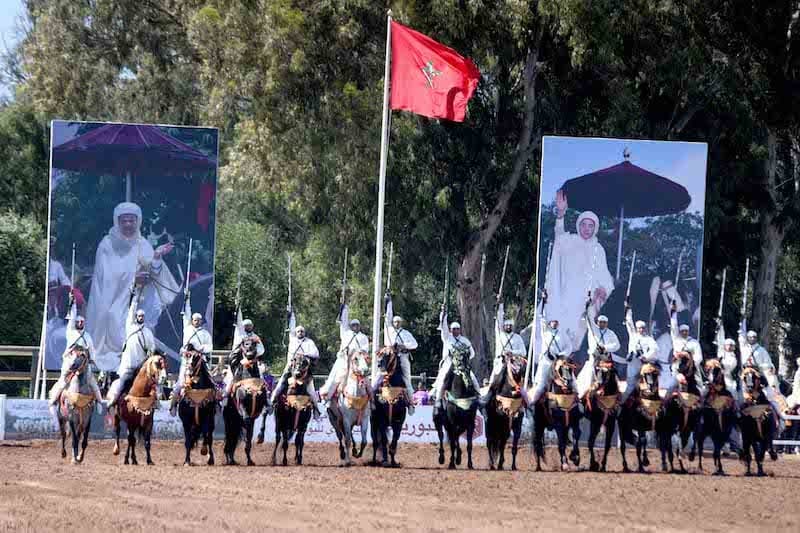
The sounds of rifles pierce the silence of "Dar es Salaam".. the Tbourida inaugurates the "Silver Jubilee".
about 2 months ago
Sport
The sounds of rifles pierce the silence of "Dar es Salaam".. the Tbourida inaugurates the "Silver Jubilee".
Hesspress Sports·
The sounds of traditional rifles returned to break the silence of the Dar Es Salam complex in Rabat this Monday afternoon, signaling the official launch of the 25th edition of the Hassan II Traditional Equestrian Award (Moroccan Championship), organized by the Royal Moroccan Equestrian Federation.
This edition features the participation of 24 teams from the national elite, divided into 18 teams in the senior category and 6 teams in the youth category. These participating teams will compete over the course of a week, hoping to win the title of "Champion of Morocco."
As in previous editions, the opening of this year's version attracted thousands of citizens, who flocked to the Dar Es Salam equestrian complex to watch the performances presented by the participating teams in this annual event, which aims to promote the "Tbourida" as a Moroccan art registered on UNESCO's lists since December 2021.
Speaking about the updates for this year's championship, Azouz Al-Bahri, an official at the Royal Moroccan Equestrian Federation (FRMSE), confirmed that "about 50 percent of the teams participating this year are competing for the first time; out of 18 teams in the senior category, we have 9 teams making their debut, and most of their riders are young people under 40 years old."
Al-Bahri explained in a statement to the Hespress website that "the remaining teams participating in the senior category are established teams that have previously accumulated a rich history of participation at the national level and have also won gold medals."
The same speaker noted that "the teams participating here for the first time have shown their high caliber, especially during the matches held between the regions, hosted in Bouznika, where they managed to outperform the best national teams." He added, "In general, all the teams that reached here are considered winners and honored, as they managed to qualify and reach the finals from among more than 360 teams that participated nationwide from Tangier to Lagouira."
The same official discussed the preparations made in advance to host the mentioned championship in its 25th edition (the silver jubilee), highlighting that "the organizing committee has taken all its measures for nearly three months and completed its logistical arrangements during the last twenty days."
"Tbourida" remains an authentic Moroccan heritage in safe hands, says Azouz Al-Bahri, noting that "the Royal Moroccan Equestrian Federation and the Royal Society for the Encouragement of Horses are making tremendous efforts to preserve horses and support riders." He added, "In Morocco, we rely on the breed of Barb-Arabian horses, which are abundant in the country. The state has allocated significant resources and capabilities to qualify them, with veterinarians present in all stables across various regions."
The launch of the Hassan II Traditional Equestrian Award (Moroccan Championship) in its 25th edition was accompanied by an enthusiastic atmosphere, both among the audience and the competing teams, highlighting the overwhelming popularity of Tbourida among specific community segments.
Before the competition began at "Dar Es Salam," the teams had completed their preparations well, as they believe that earning points comes through good and optimal performance in all displays, with judging committees checking the accuracy of the shots, the coordination of movements, and the costumes.
Mahdi Blous, the leader of a team from the province of Skhirat-Témara, emphasized the importance of his team's participation in these competitions after qualifying in fifth place during the elimination stage. He added, "The new thing this year is that we managed to qualify since the first round to participate in this championship."
Blous noted in a statement to Hespress that "half of the teams participating in the senior category are led by new leaders, and I am one of them, while the other teams are led by experienced practitioners."
The same "leader" spoke about the uniqueness of the riders' attire in the Skhirat-Témara region, saying: "The area is characterized by a playing style called 'Khayatiya,' which is completely different from the styles of other regions; the area is also distinguished by the authentic Moroccan dress consisting of 'white farrajia,' in addition to the 'Bzioui selham' adorned with specific decorations."
For his part, Mohamed Amin Talhouni, the leader of a team from Mazamaza Sidi Al-Aidi in the province of Settat, stated that his team "represents the Eastern method in the art of Tbourida, which is an excellent and distinctive method, and it is also found in other areas, such as Beni Mellal and Fkih Ben Salah, with some differences in the touches."
Talhouni explained in his conversation with the newspaper that his team's ambition and main goal is "to reach the farthest point in this competition, and why not win the Championship of Morocco," also confirming that "safety remains a priority in such championships."
This year's edition of the Hassan II Award for Traditional Equestrian Arts features the participation of teams from various provinces and regions, as follows:
Skhirat-Témara, Jerfif, Oujda, Khémisset, Safi, Qalaat Sraghna, Settat, Mohammedia, Sidi Bennour, Fkih Ben Salah, Marrakech Beni Mellal, Guelmim, and Sidi Ifni. In the youth category, the participating teams represent the provinces of Khémisset, Taourirt, Jerfif, Youssoufia, Mediouna, and finally Guelmim.
In addition to preparing the competition arena for the teams, the organizers ensured the provision of spaces that highlight the crafts related to the art of Tbourida, such as saddle making and riders' clothing.
The spaces prepared for this purpose allow visitors to get to know traditional equestrianism (Tbourida) closely, as it is a comprehensive system of crafts, knowledge, and experiences passed down from generation to generation.
Moreover, visitors learn about the methods of caring for horses and monitoring them from a veterinary perspective, as well as the measures necessary to ensure their readiness for competitions and maintain their physical fitness optimally.